Leon Jenkins · 2 November 2026
Varied Wind Patterns Alter Sediment Movement and Marine Reproduction Sites on Open Coastlines
Coastal researchers track how fluctuating wind speeds and directions modify the movement of sand and other materials along exposed shorelines, which in turn affects areas where marine species deposit eggs and larvae. Monitoring stations along the Pacific and Atlantic coasts have collected data showing these connections since the early 2000s, with recent records from November 2026 highlighting continued shifts in wind regimes that redistribute sediment and influence habitat suitability for fish populations.
Exposed shorelines experience direct impacts from prevailing winds that generate waves capable of eroding or depositing material in patterns that change seasonally. Data collected by the National Oceanic and Atmospheric Administration indicate that increases in wind variability correlate with accelerated sediment transport rates in regions such as the California Current system, where longshore currents carry particles over distances measured in kilometers during high-wind events.
Mechanisms of Wind-Driven Sediment Redistribution
Wind variability influences wave energy spectra, which determine how sediment particles of different sizes sort themselves along the beach profile. Stronger gusts create higher-energy waves that suspend finer grains and move them offshore, while calmer periods allow coarser materials to settle closer to shore. Studies from the Commonwealth Scientific and Industrial Research Organisation in Australia have documented similar processes on the southeast coast, where wind direction reversals lead to net sediment gains or losses depending on the angle of wave approach relative to the shoreline orientation.
These transport dynamics create feedback loops because altered beach slopes then modify how subsequent waves break and refract. Observers note that such adjustments occur over weeks to months, with cumulative effects becoming visible in bathymetric surveys conducted annually. Buoy arrays deployed off the Oregon coast, for instance, record wind speed fluctuations that precede measurable changes in nearshore sandbar positions within days.
Impacts on Marine Spawning Habitats
Marine species that rely on specific substrate conditions for spawning face habitat alterations when sediment flows shift. Flatfish and certain forage fish select sandy or gravelly patches for egg deposition, and these patches can become buried or exposed depending on net transport directions. Research compiled by Fisheries and Oceans Canada shows that wind-driven changes in sediment composition along British Columbia's outer coast coincide with variations in larval survival rates for Pacific herring during spring spawning seasons.
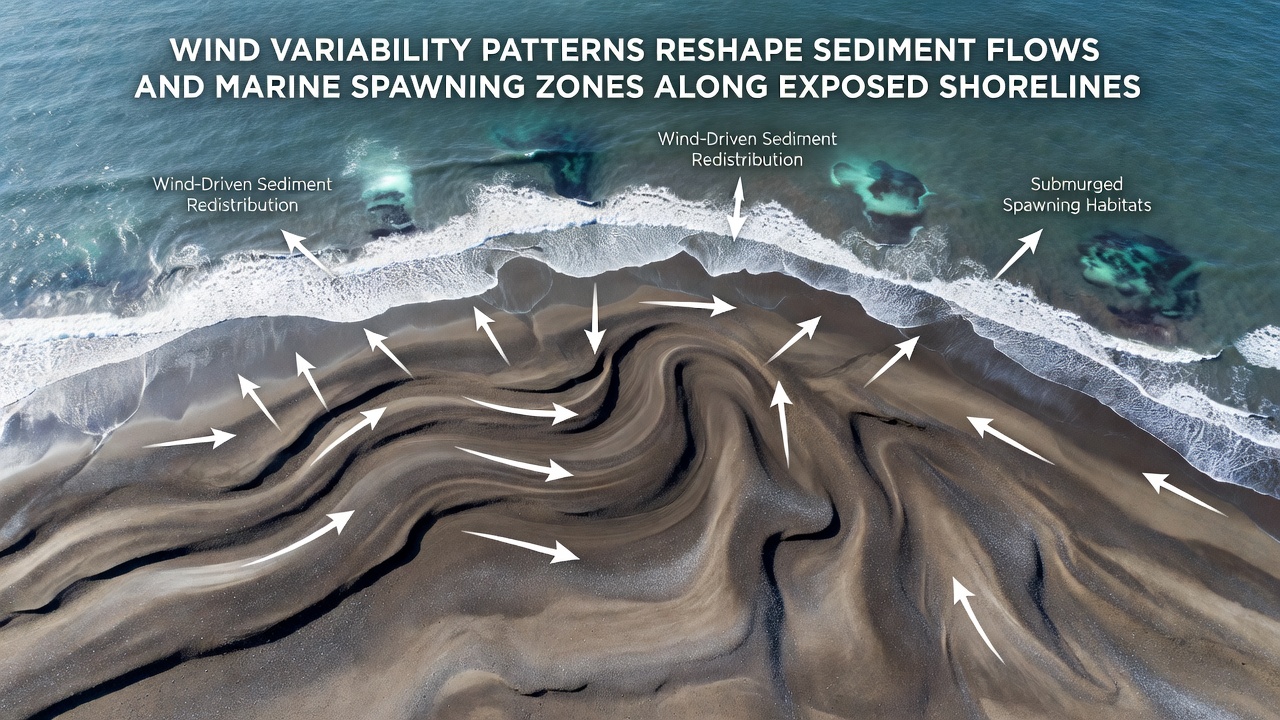
Water column mixing also plays a role, since stronger winds increase turbulence that can disperse or concentrate planktonic food sources near spawning grounds. Data from the European Environment Agency coastal monitoring programs reveal that periods of elevated wind variability in the North Sea correspond with shifts in the spatial distribution of sandeel spawning sites, which move in response to changing bed shear stress. Such movements affect the overlap between spawning adults and suitable conditions for egg attachment.
Regional Observations and Data Trends
Along the exposed coasts of New Zealand's South Island, wind records from the National Institute of Water and Atmospheric Research demonstrate that increased variability in westerly winds has lengthened the duration of sediment suspension events. This extension reduces the stability of nearshore gravel beds used by several endemic fish species for reproduction. Similar patterns appear in the Baltic Sea, where the Swedish Meteorological and Hydrological Institute reports that wind shifts during autumn months redistribute finer sediments into deeper channels, limiting available spawning area for Baltic herring.
Long-term datasets allow comparison across decades. Analyses covering 1990 through 2026 show that the frequency of wind direction changes exceeding 45 degrees within 24-hour periods has risen in multiple mid-latitude regions. These changes align with measured increases in the rate of sediment flux across the shoreline, measured in cubic meters per meter of beach width per year.
Monitoring Approaches and Future Data Collection
Networks of acoustic Doppler current profilers and sediment traps provide continuous measurements that link wind forcing to transport outcomes. Satellite-derived shoreline positions supplement these in-situ records by capturing broader spatial patterns. Integration of these sources allows researchers to model scenarios where wind variability continues its observed trajectory through the late 2020s.
Collaboration among agencies in different ocean basins improves the robustness of findings. Joint efforts between North American and European institutions have standardized protocols for classifying wind events according to their duration and directional persistence, which helps isolate the specific conditions most responsible for sediment and habitat changes.
Conclusion
Wind variability continues to drive measurable adjustments in sediment distribution and the location of marine spawning zones along exposed shorelines worldwide. Ongoing data collection from established monitoring systems supplies the information needed to quantify these relationships across seasons and regions. The connections between atmospheric forcing, physical transport processes, and biological habitat requirements remain central to understanding coastal ecosystem responses.