Leon Jenkins · 7 September 2026
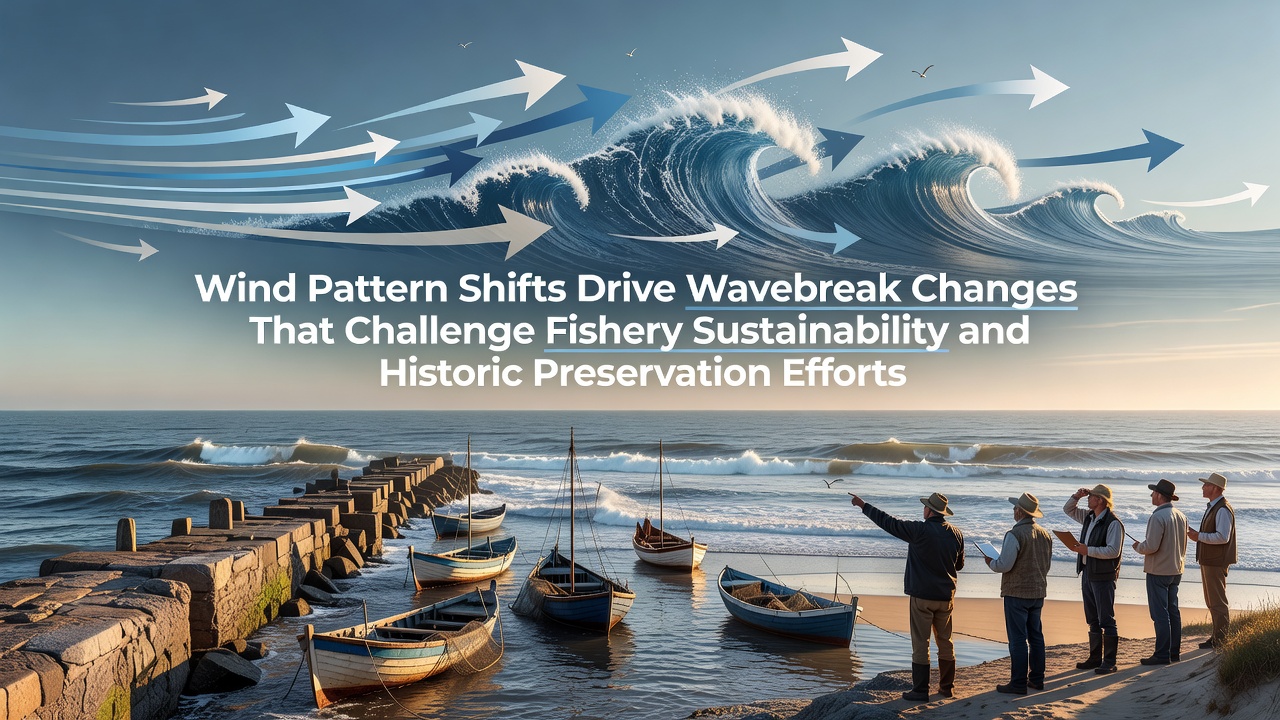
Wind Pattern Shifts Drive Wavebreak Changes That Challenge Fishery Sustainability and Historic Preservation Efforts
Wind pattern shifts have begun reshaping wavebreak formations along multiple coastlines, and these alterations directly influence both marine ecosystems and longstanding coastal structures according to recent monitoring programs. Researchers tracking atmospheric changes note that altered jet stream positions contribute to modified wind directions which in turn modify how waves break near shore, and this process affects sediment transport while changing habitat conditions for various fish species. Data collected through satellite observations and buoy networks reveal consistent trends across the Pacific and Atlantic basins since the early 2020s.
Changes in Atmospheric Circulation and Wave Dynamics
Global circulation models from multiple agencies show that poleward shifts in prevailing winds have intensified in several regions, and these movements create new wave energy distributions that erode traditional wavebreak zones while building others elsewhere. Observers note that wave heights and periods adjust accordingly, which influences nearshore currents and the stability of underwater sandbars that serve as natural barriers. In September 2026, updated datasets from international weather services confirmed accelerated changes in the Northern Hemisphere subtropics where wind anomalies reached levels not previously recorded in the instrumental record.
Coastal engineers have documented corresponding adjustments in wave refraction patterns, and these modifications alter how energy dissipates before reaching shorelines. Such dynamics matter because wavebreaks protect both commercial fishing grounds and archaeological sites that sit just above the high-tide line. When wind-driven wave energy concentrates in new locations, previously stable areas experience increased turbulence that can dislodge juvenile fish populations and undermine foundations of historic buildings.
Effects on Fishery Sustainability
Fishery managers report that species dependent on specific wavebreak-protected nurseries face habitat compression as wind patterns evolve, and this compression reduces available spawning grounds for several commercially important stocks. Studies conducted by the Department of Fisheries and Oceans Canada indicate that altered wave climates have shifted distribution ranges for groundfish, while Australian Institute of Marine Science surveys document parallel movements among reef-associated species along the eastern seaboard. These range shifts create new management challenges because existing quota systems and seasonal closures were designed around historical wave and current conditions.
What's interesting is that recruitment success for some pelagic species has declined in zones where wave energy now exceeds thresholds tolerated by early life stages, and this decline compounds pressures from temperature increases already affecting ocean productivity. Government monitoring programs continue to track these interactions, and preliminary figures from 2026 show measurable drops in catch per unit effort within traditional fishing grounds that once benefited from consistent wavebreak shelter.

Implications for Historic Preservation
Historic preservation agencies have identified rising risks to coastal heritage sites because modified wavebreaks allow greater wave run-up during storm events, and this increased exposure accelerates deterioration of stone foundations and wooden pilings at locations designated as cultural landmarks. European Environment Agency assessments highlight similar vulnerabilities along the Mediterranean where wind regime changes have exposed previously sheltered Roman and medieval ruins. In the United States, National Park Service records note accelerated erosion rates at several 19th-century coastal forts where protective sandbars have migrated due to shifting wave directions.
Preservation teams now incorporate wave modeling into site management plans, and these models help prioritize reinforcement measures before irreversible damage occurs. The connection between atmospheric circulation changes and cultural resource loss has prompted collaboration between meteorologists and archaeologists who share data on how wave energy redistribution threatens both living marine resources and non-living heritage assets.
Integrated Monitoring and Future Projections
Integrated observation networks combining meteorological, oceanographic, and archaeological data streams provide the clearest picture of ongoing adjustments, and these networks enable more accurate forecasts of where wavebreak changes will next intensify. Projections based on continued wind pattern evolution suggest further redistribution of wave energy through the remainder of the decade, which will require adaptive strategies in both fishery regulation and site protection protocols. International coordination through bodies such as the Commonwealth Scientific and Industrial Research Organisation and corresponding agencies in other regions supports shared modeling efforts that account for regional variations in wind-driven impacts.
Conclusion
Wind pattern shifts continue to drive measurable changes in wavebreak configurations, and these changes intersect with the needs of sustainable fisheries alongside the preservation of historic coastal sites. Ongoing data collection through September 2026 and beyond will refine understanding of these coupled processes, while management responses evolve to address the spatial mismatches that arise when established wave regimes no longer match current conditions. Coordinated observation and planning remain central to maintaining both ecological and cultural values along affected shorelines.